
Listen
A short audio summary of the paper
Generated with AI. Check the original paper before relying on this summary.
Clinical Bottom Line
Opioid rotation is a fundamental skill in palliative care and pain management, yet the "math" behind it varies significantly between institutions and clinicians.
This scoping systematic review aimed to synthesize the current state of evidence regarding opioid analgesic dose and route conversion ratios. The goal was to provide a data-driven foundation for an upcoming international eDelphi guideline.
Key Findings
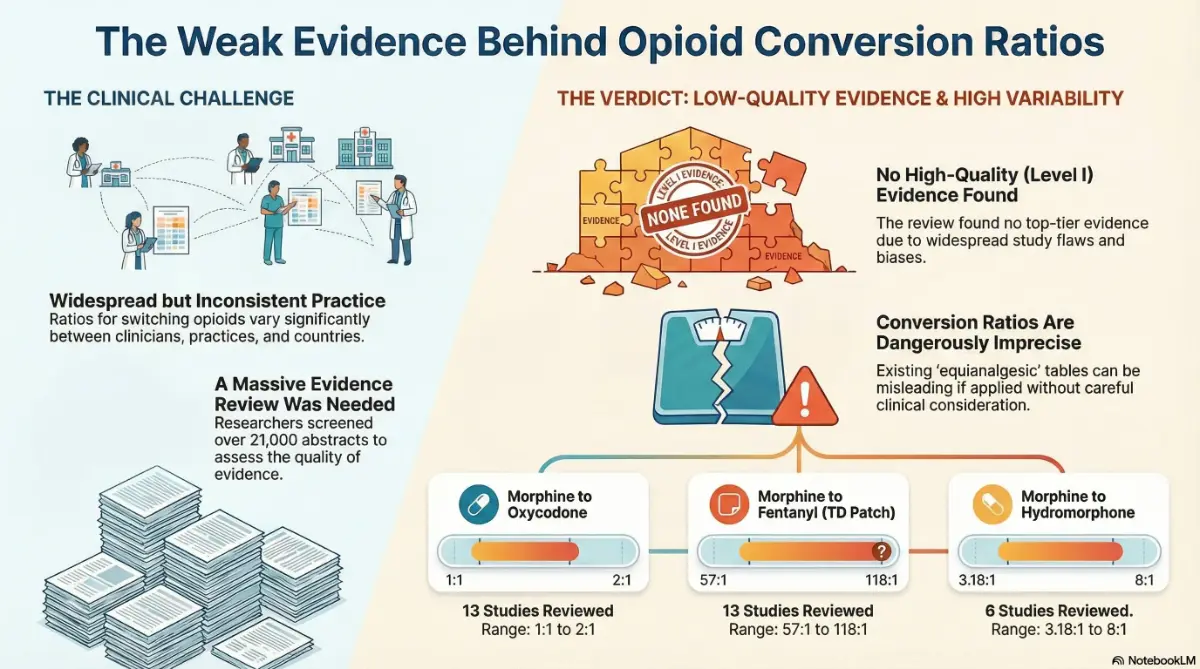
- Volume vs. Quality: The authors identified 21,118 abstracts and included 140 randomized and 68 non-randomized clinical trials. Despite this volume, the overall quality of evidence supporting definitive conversion ratios was deemed low.
- Variability: Current conversion ratios used in practice vary widely, confirming the need for standardization.
- Correlation: There were "modest correlations" between the review's findings and recently published conversion ratios, but gaps remain.
Clinical Takeaway
"We rely heavily on conversion tables, but this review highlights that the 'gold standard' ratios often lack high-quality evidence. Clinicians should continue to treat calculated equianalgesic doses as estimates only, requiring close clinical monitoring during rotation."
Important
This audio and written summary was generated with AI for educational use. It is not medical advice. Check the original paper and use professional judgement.